Amazing Octopus Facts for Kids: 3 Hearts, Blue Blood and Incredible Ocean Secrets
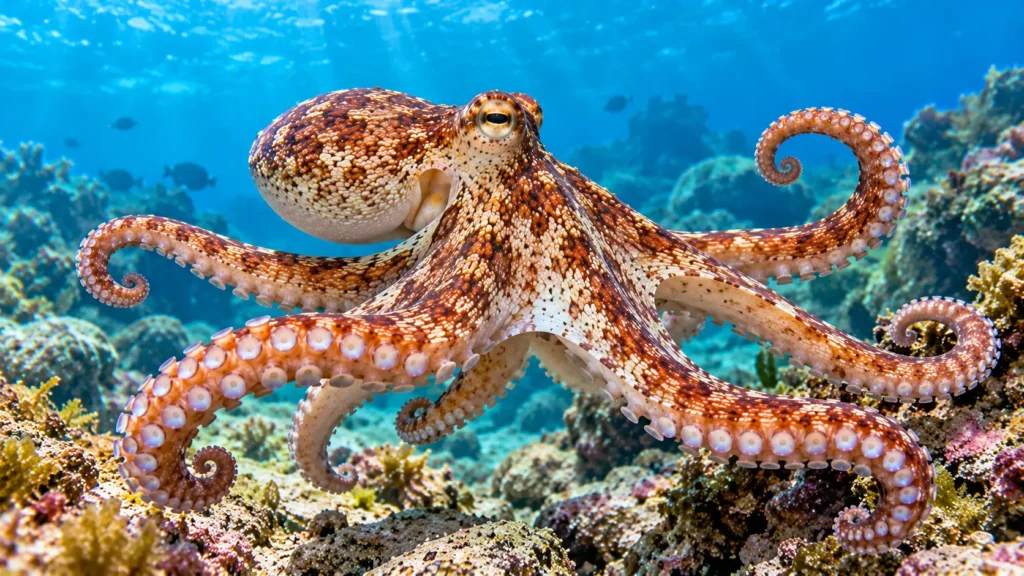
Did you know that an octopus has three hearts, blue blood and eight flexible arms? Some octopuses are capable of changing their appearance in just seconds!These amazing octopus facts for kids reveal how octopuses use their three hearts, blue blood, flexible arms and colour-changing skin to survive in the ocean.
Octopuses are one of the most interesting animals living in the ocean. These smart marine animals are able to solve problems, squeeze through small gaps and use amazing camouflage for hiding from predators.
Some octopuses have even been seen carrying coconut shells to make shelters!
Why does an octopus have three hearts? Why is its blood blue? Can an octopus use tools? Let’s find out these amazing octopus facts and learn the science behind these extraordinary ocean animals.Curious about other small creatures? Discover the differences in our Snail vs Slug guide.
Amazing Octopus Facts for Kids: What Makes Them Special?
An octopus is a soft Body animal belongs from class of animals called molluscs.
octopus is varied from other molluscs because it does not have a shell. Their soft bodies help them to squeeze through small gaps and help them to hide.
There are hundreds of octopus species living in oceans all over the world. Different species live in coral reefs, rocky shores, sandy sea bottoms and the deep ocean.
Although octopuses differ in size, colour and behaviour, they share several fascinating characteristics.
Quick Facts About Octopuses
Feature | Fact |
Scientific order | Octopoda |
Animal group | Molluscs |
Number of arms | Eight |
Number of hearts | Three |
Blood colour | Blue when oxygenated |
Habitat | Oceans around the world |
Diet | Carnivorous |
Skeleton | No rigid internal skeleton |
Intelligence | Can learn and solve problems |
Defence | Camouflage, hiding and ink release in many species |
Reproduction | Egg-laying |
Lifespan | Varies by species |
Fast answer: An octopus is an animal with eight arms, three hearts, blue blood because it has copper and a well developed nervous system. They can change their skin colour ,problem solving and adopt different survival tactics.
1. Why Does an Octopus Have Three Hearts?
One of the most amazing octopus facts is that it has three hearts! There is a specific function for each heart. Branchial hearts – there are two. They transport the blood into the gills, where it is enriched with oxygen. Systemic heart – it pumps the oxygenated blood throughout the body. This unique circulatory system aids in oxygen transportation within the octopus’ body.
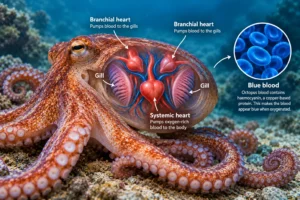
Interestingly enough, the systemic heart does not beat while swimming because of the intensity of the process. Many octopus species prefer crawling on the ocean floor to avoid active swimming. However, if there is a need to move fast, they are able to expel water from a muscular tube called a siphon. It is called jet propulsion. Amazing fact: An octopus has three hearts; however, the one responsible for pumping blood throughout its body does not work while actively swimming!
2. Why Does Octopus is with Blue Blood?
Human blood is red due to the presence of haemoglobin that carries oxygen. This protein has iron in it. The octopus has another protein in its blood system known as haemocyanin. Instead of iron, haemocyanin has copper. When oxygen binds to this protein, the blood becomes blue. This is the reason why the blood of octopuses becomes blue when it has oxygen. The function of haemocyanin is to carry oxygen in the body of the octopus. Remarkable fact: Haemocyanin in the blood system of an octopus makes the oxygen-filled blood blue.
3. How do Octopuses Change Their Colour?
It is incredible to observe the octopus vanishing on the rocky ocean seabed! Octopuses belonging to numerous types are capable of changing the colouration, skin patterns, and skin structure rapidly to match their environment. Thus, a restive octopus can blend in with stones around him. Others will blend in with sandy or coralline substratum.
What Are Chromatophores?
They are special skin cells with pigments contained in them. It is possible to control the expansion of these structures by special muscles that are used for controlling pigments’ visibility and, as a result, skin colour. Also, other skin constructions will allow reflecting light, and muscles can change skin textures. Therefore, camouflaging is extremely successful in the case of octopuses!
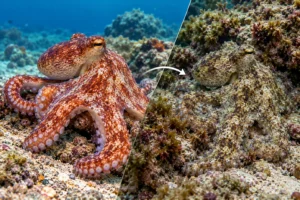
Why Do Octopus Uses Camouflage? By hiding using camouflage, octopuses can avoid predators and catch prey easily and unnoticed. Also, some species use their camouflaging in their relations with other organisms. Fascinating fact: An octopus can be so quick-changing the skin patterns that it seems to vanish in the environment!
4. How Intelligent Is Octopus?
Octopus is the most intelligent in invertebrate. They learn from experience, solve problems and manipulate objects. Some octopuses can open boxes to access food inside. Some other octopuses show their intelligence in scientific experiments. Moreover, their nervous system is special as well.
Do Octopuses Have Nine Brains?
Probably, you’ve heard the saying that an octopus has nine brains. It is a misleading idea. An octopus has one brain and an extensive nervous system. The majority of its nerve cells are located in its arms and assist in processing sensory signals and moving arms. As a result, its arms can do some actions without the participation of the brain.
Interesting fact: an octopus has one brain, but its arms also have a large amount of nerve cells!
5. Can Octopuses Use Tools?
Absolutely! Scientists have noticed that the veined octopus, Amphioctopus marginatus, carries coconut shells. Scientists have found in an article published in 2009 that this kind of octopus collects discarded coconut shell halves from the sea bottom. They use them for creating shelters when needed. When carrying the coconut shells, the animals might be moving in an awkward manner, but this will give them a shelter in the future. Scientists refer to this behaviour as a defensive tool use. This is the case where scientists have proved that at least some species of octopuses can collect items, carry them and use for their future needs. Still, this behaviour shouldn’t be applied to all octopus species.
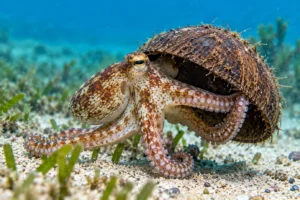
Interesting fact: Some octopuses use coconut shells as shelters!
6. Why Do Octopus Has Eight Arms?
The octopus has eight muscular arms which is covered with suckers. The arms enables them to move, grab food ,to hold objects and to investigate the environment. Unlike the human arms, the arms of the octopuses do not have bones. They have a flexible muscular structure which enables them to bend in various directions.
Do Octopuses Tastes with Their Arms?
Yes! The suckers have sensory receptors which can sense chemical signals. It helps the octopuses to investigate objects and to get information on possible food. it has eight arms not tentacles.
Amazing fact: The octopus uses its eight flexible arms for gripping things, investigate the environment and to catch its prey.
7. How Do Octopuses Escapes from Predators?
Octopus has more number of mechanisms for self-protection.
Camouflage: Many animals can changes their colours to resemble like rocks,sand and corals.
Release of ink: Many octopuses release a cloud of dark ink when faced a threat,predator and giving them a chance to escape.
Jet propulsion: An octopus ejects water from siphon to make fast motions from the opposite side.
Hiding:flexibe body of octopus body allows to hide in the cracks of the rock.
Also octopuses do not have a bones, which helps them squeeze through small gaps but due to the hard beak it doenot squeeze through small gaps.
Cool fact: An octopus can employ all three mechanisms mentioned above to escape danger.
8. What Do Octopuses Eat and Where Does Octopuses Live?
Octopuses are carnivores – they eat other animals.
Depending on the species, their diet can include:
- Crabs
- Shrimp
- Clams
- Snails
- Other molluscs
- Some fish
Octopuses uses their arms and suckers to catch their prey and their hard beak helps them in feeding.
Where Does Octopus Lives?
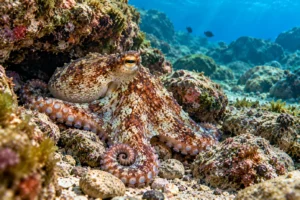
Octopuses live in marine environments around the shallow coastal water,coral reefs,rocky seabeds or sandy ocean floors.
Deep-sea octopuses inhabit darker, colder environments under enormous water pressure.
Many species uses cracks of rocks or holes in seabed for shelter.
Amazing fact: Octopuses live in a wide habitats from shallow coastal waters to deep oceans.
9. How Does Mother Octopuses Protect Eggs?
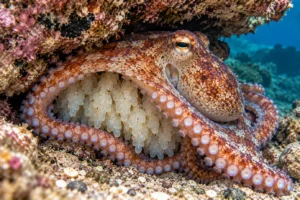
Female octopuses lays eggs in safe places.mothers stay near the eggs until the baby octopuses are ready to hatch. female octopuses clean the eggs and circulate water around the eggs which will help the babies breathe and keep the eggs clean from dirt. The time of this happening differs among various species.
Can an Octopus Protect Her Eggs for Four Years?
Yes,Researchers discovered that one female octopus, Graneledone boreopacifica, guarded its eggs for 53 months or approximately four and half years.
10. How Long Do Octopuses Live? And Do Octopuses Recognise People?
Different octopuses species have different lifespans.
Most species live for about one to two years; however, some bigger species may live for several years.
For most species, reproduction happens near the end of the octopus’ life. Females may spend a lot of effort caring for their eggs and dying after they hatch.
Can Octopuses Recognise Humans?
There is research that shows that some octopuses can recognise individuals.
According to a 2010 study that involved eight giant Pacific octopuses, there were differences in their behaviour towards two people. One person was always feeding the octopuses, and another was touching them with a bristly stick.
These results show that octopuses were able to distinguish between those two people under the given circumstances. However, these results cannot be applied to all octopus species.
Amazing fact: According to scientific research, some octopuses can recognise individual people!
FAQ
1. Why does an octopus have three hearts?
An octopus has three hearts because its blood circulates through a special system. Two hearts pump blood to the gills to collect oxygen, while the third sends oxygen-rich blood to the rest of its body.
2. Is octopus blood really blue?
Yes! Unlike humans, octopuses use a copper-containing protein called haemocyanin to carry oxygen. When this protein binds to oxygen, the blood appears blue.
3. Does an octopus really have nine brains?
Not exactly! An octopus has one central brain, but its arms also contain many nerve cells. These help the arms sense and respond to their surroundings, sometimes without waiting for instructions from the central brain.
4. How can an octopus change its colour so quickly?
An octopus has special structures in its skin called chromatophores. By controlling these structures, it can rapidly change its colour patterns. This helps it blend into rocks, sand and coral.
5. What is the longest time an octopus has guarded its eggs?
Scientists observed a deep-sea octopus guarding her eggs for 53 months—that’s about four and a half years! The cold deep-sea environment slows egg development, helping explain this unusually long period.
Conclusion
The octopus is a fascinating sea creature, having three hearts, blue blood, and eight flexible arms. They are also very capable of changing color, solving problems, tool use, and escaping from their predators. One of the most interesting discoveries made is that an octopus living in the deep ocean has incubated her eggs for a period of about four and a half years! We know very little about such fascinating creatures and their underwater habitats.We hope these amazing octopus facts for kids inspire you to discover more about the fascinating creatures living in our oceans.
Scientific References
1. Smithsonian Ocean. Cephalopods: Octopus, Squid, Cuttlefish and Nautilus.
2. Smithsonian Ocean. How Octopuses and Squids Change Color.
3. Finn, J. K., Tregenza, T., & Norman, M. D. (2009). Defensive Tool Use in a Coconut-Carrying Octopus. Current Biology.
4. Robison, B., Seibel, B., & Drazen, J. (2014). Deep-Sea Octopus (Graneledone boreopacifica) Conducts the Longest-Known Egg-Brooding Period of Any Animal. PLOS ONE.
5. Anderson, R. C., Mather, J. A., Monette, M. Q., & Zimsen, S. R. M. (2010). Octopuses (Enteroctopus dofleini) Recognize Individual Humans. Journal of Applied Animal Welfare Science.